
Etowah County Criminal Court Records
Etowah County criminal court records are maintained through the Circuit Clerk's Office for District and Circuit Court proceedings. District Criminal handles misdemeanor arrests, non-uniform citations, conservation violations, felony first appearances, preliminary hearings, bond fees, costs, and fines. Circuit Criminal handles felony matters and misdemeanor appeals from Etowah District Court and Gadsden Municipal Court.
The full criminal court record is the case file. It can include the charging document, arraignment, appointed or retained counsel events, motions, notices, hearing settings, docket entries, plea, trial result, disposition, sentence, costs, fines, probation terms, suspended sentence entries, and appeal filings. For a closer look at arrest records and charges filed after arrest, use the arrest and charge record page rather than treating the booking roster as the court case file.
The Etowah Circuit Criminal page is a key local source for felony criminal process and docket notes.
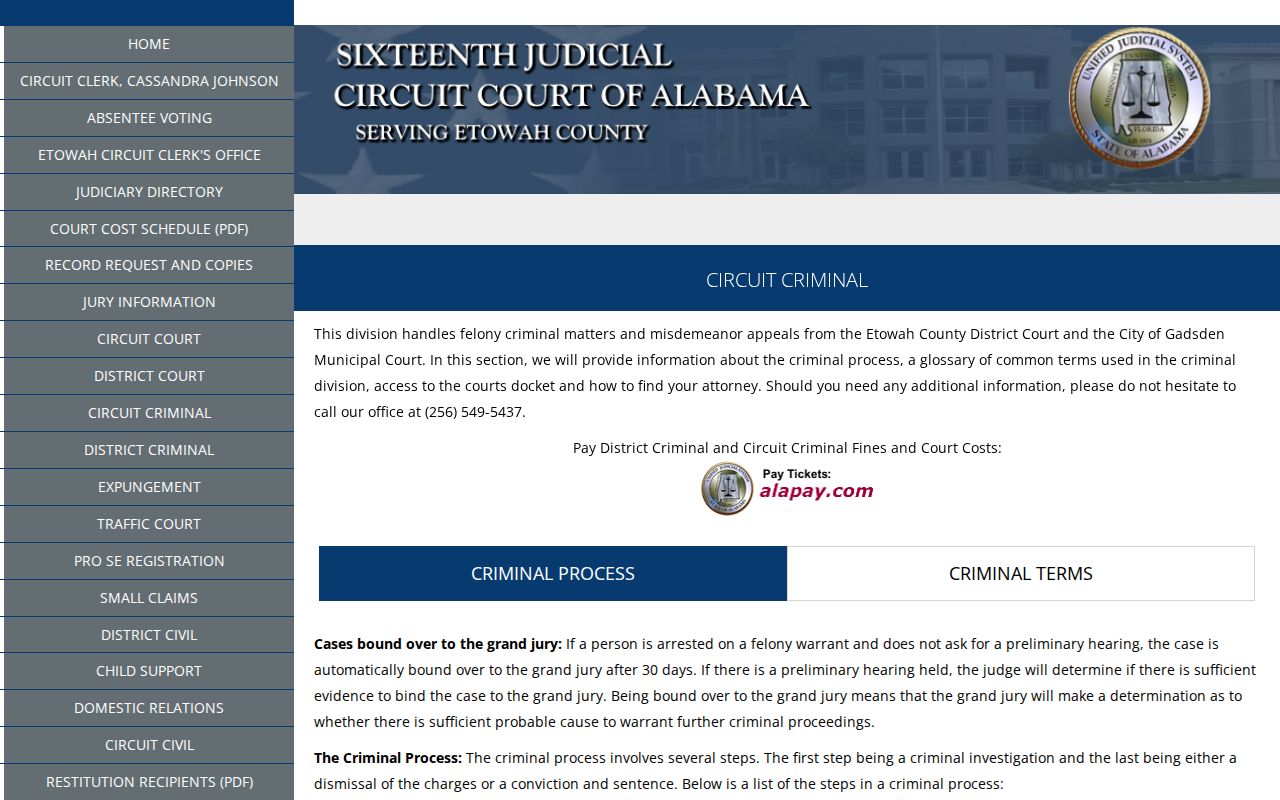
Circuit Criminal is where the felony case file, later criminal docket events, and sentencing record are most likely to appear after indictment.
Search Etowah County Criminal Records
Online trial court access is through Alacourt ACCESS, which provides Alabama trial court records for civil, domestic, criminal, and traffic categories through an account and fee-gated system. Local access is through the Circuit Clerk public terminal for public record name searches during Judicial Building business hours. Copies, certified copies, older files, pleadings, and orders require the clerk's written request process.
- Decide whether the criminal record is District Criminal, Circuit Criminal, municipal, state prison, or federal.
- Use Alacourt ACCESS for online District and Circuit trial court case lookup when account access is available.
- Use the Circuit Clerk public terminal for an in-person public name search.
- Submit a written request with case number, defendant name, date of birth or alias, charges, case type, and requested documents.
- For certified copies, state that certification is needed and pay the clerk certification fee.
The Etowah District Criminal page covers misdemeanor charges, first appearances, bond, fines, and preliminary-hearing information.
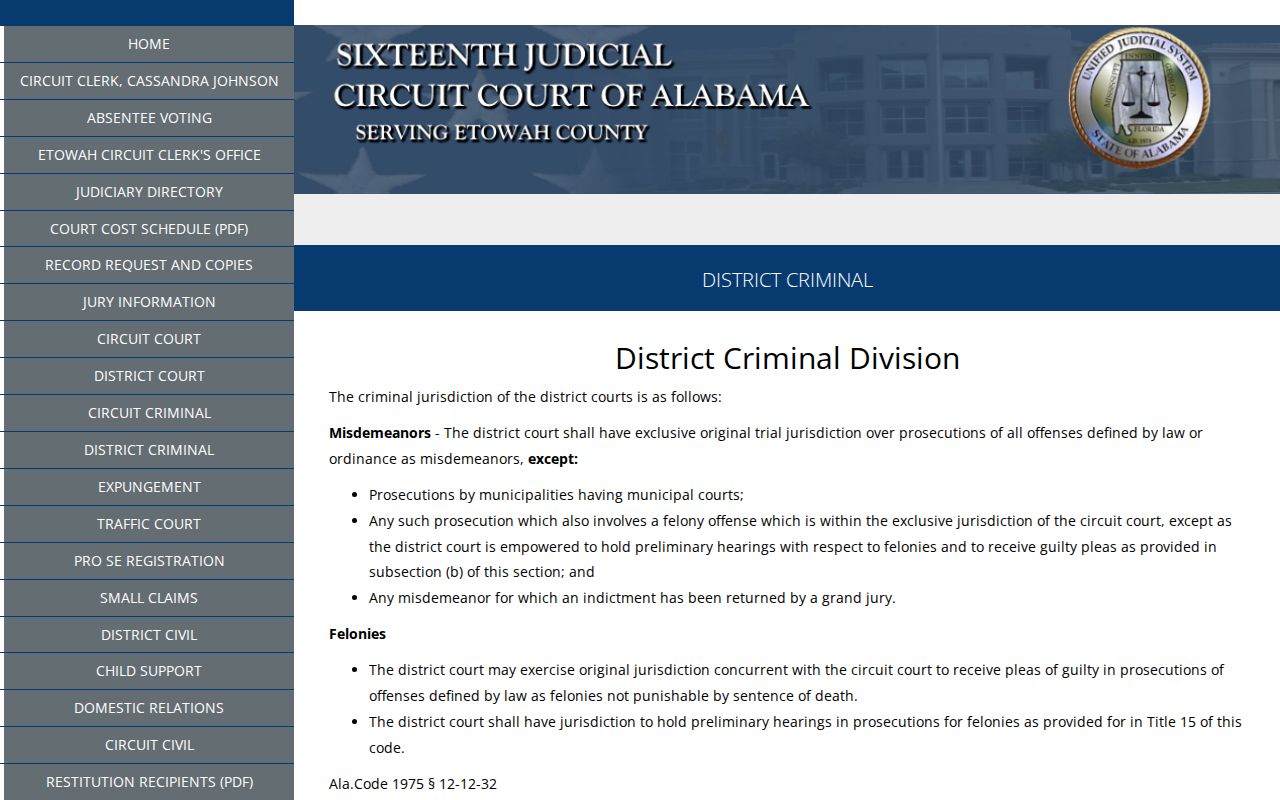
District Criminal records are especially important at the beginning of misdemeanor cases and felony preliminary-hearing cases.
Etowah County Criminal Case Flow
A criminal court record changes as the case moves. A felony may start with arrest and first appearance in District Court. If probable cause and prosecution continue, the case can move to grand jury, indictment, and a Circuit Court criminal case number. Misdemeanor cases may remain in District Court unless appealed. Court notices and discovery information go to the attorney after counsel is appointed or retained, and Circuit Criminal judges set individual dockets.
Case flow: Charges Filed › First Appearance › Preliminary Hearing › Grand Jury or District Case › Arraignment › Pretrial Motions › Plea or Trial › Disposition › Sentencing › Appeal.
| Stage | What the Court Record May Show |
|---|---|
| Charges filed | Initial charge text, complaint, information, or indictment depending on case route. |
| First appearance | Representation, bond, release terms, and preliminary scheduling. |
| Arraignment | Formal reading or notice of charges and entry of plea. |
| Pretrial motions | Written requests asking the judge to act before plea or trial. |
| Plea or trial | Guilty plea, not guilty trial result, dismissal, acquittal, or other outcome. |
| Sentencing | Fine, jail, prison, probation, suspended sentence, costs, or restitution. |
Etowah County Criminal Record Fields
Criminal court records can contain more than a charge line. The Circuit Clerk manages pleadings, court notices, trial and hearing schedules, funds, fines, fees, and filings. A complete file may include documents attached or issued by the court, such as subpoenas, warrants, orders, notices, motions, income or financial entries, and final sentencing material.
| Field | What It Shows |
|---|---|
| Case number | The District or Circuit Court identifier used for searches, payments, and copy requests. |
| Defendant | The person charged by the State of Alabama or a municipal prosecution on appeal. |
| Charges | Filed counts, amended charges, dismissed counts, or indictment language. |
| Plea | Guilty, not guilty, or other plea activity in the criminal case. |
| Disposition | Final or current outcome, such as conviction, dismissal, acquittal, or nolle prosequi. |
| Sentence | Fine, costs, probation, jail, prison, suspended sentence, or related terms. |
| Financial entries | Court costs, fines, restitution, bond fees, and payment activity. |
Charges and Convictions in Etowah
A charge is an accusation filed or carried in the criminal case. A conviction is an outcome after plea or trial. Etowah County criminal court records may show charges that were amended, reduced, dismissed, dropped, or ended in nolle prosequi. That is why the disposition and sentence fields matter as much as the charge field.
| Issue | Charge | Conviction |
|---|---|---|
| Meaning | An accusation or count filed in court. | A final finding or plea of guilt on a count. |
| Timing | Appears early and may change as the case proceeds. | Appears after plea, trial, or final judgment. |
| Record risk | May remain visible even when later dismissed unless sealed or expunged. | May trigger sentence, fines, probation, jail, or prison. |
Restricted Criminal Court Records
Juvenile records are not ordinary public criminal files. Sealed, expunged, mental health, and certain domestic or protection records may also be restricted or redacted. Discovery is another common source of confusion: the Etowah Circuit Criminal page says discovery is not part of the clerk's criminal file and must be obtained from the attorney of record.
Etowah's expungement guidance directs petitions for records from Etowah District Court or municipal courts in the county to the Circuit Criminal Division. It points users to Form 65 through Alabama E-Forms and to the ALEA criminal record expungement kit. The local guidance states that the filing fee is $500, the district attorney or municipal prosecutor has 45 days to object, and ruling notice may take up to 60 days.
| Record Type | Public Access Status | Etowah County Route |
|---|---|---|
| Juvenile | Restricted | Juvenile division, parties, attorneys, agencies, or court order. |
| Sealed | Restricted by court order | Access depends on the sealing order. |
| Expunged | Removed or sealed under statute | Petition through Circuit Criminal when eligible. |
| Discovery | Not part of clerk file | Attorney of record, not the Circuit Clerk counter. |
The Etowah expungement page is one of this page's image sources.
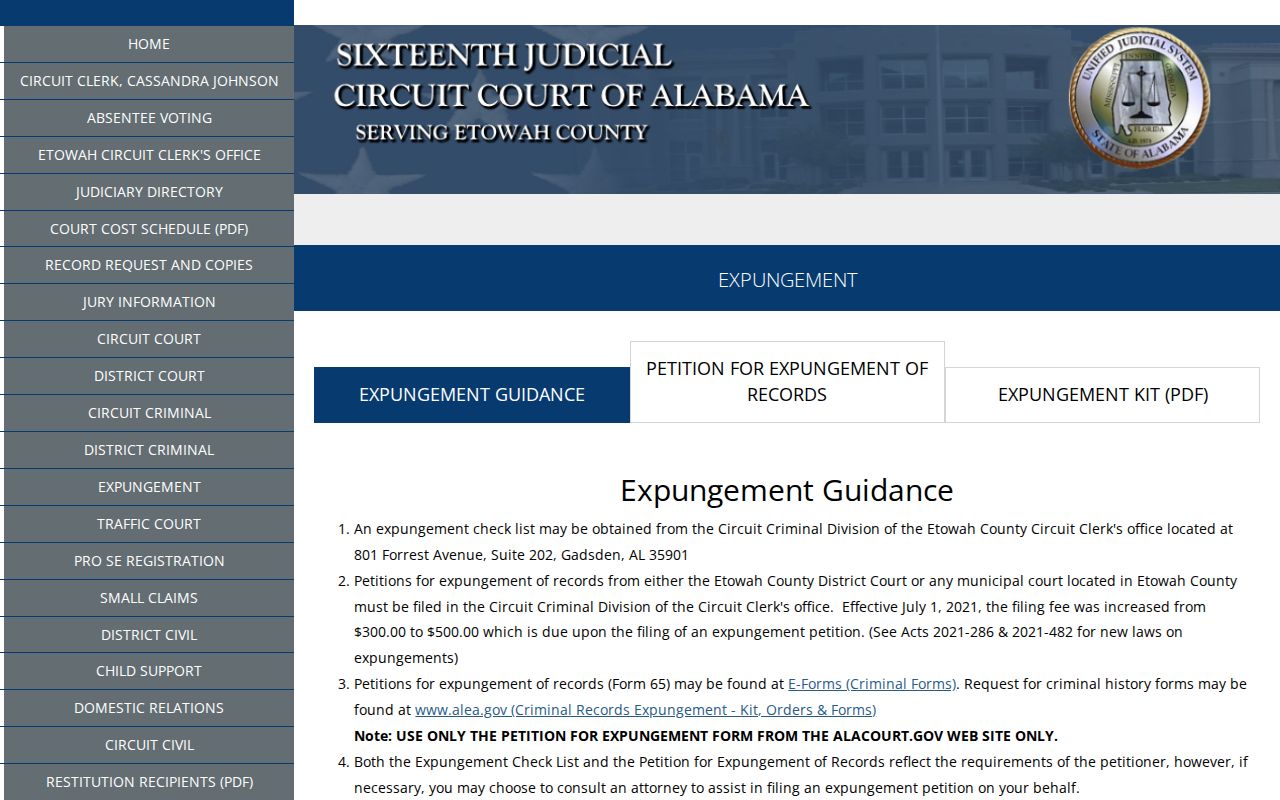
Expungement is the court process that can change public access to certain qualifying criminal records.
Etowah Criminal Records Access Law
Alabama's general public-records statute, Ala. Code 36-12-40, gives residents the right to inspect and copy public records unless another law restricts access. Ala. Code 15-27-1 is part of Alabama's expungement framework for certain criminal records.
Federal criminal cases are separate. Etowah County is in the Northern District of Alabama, and federal records use PACER or CM/ECF rather than the Etowah Circuit Clerk. The U.S. Attorney's Office for the Northern District of Alabama is a prosecution source for federal cases, not county misdemeanor or ordinary state felony files.
The Northern District U.S. Attorney source is assigned in the manifest.
Use federal sources only when a case was filed federally; most Etowah County criminal court records remain in state trial court systems.
The Alabama expungement statute image is also assigned for criminal court records.
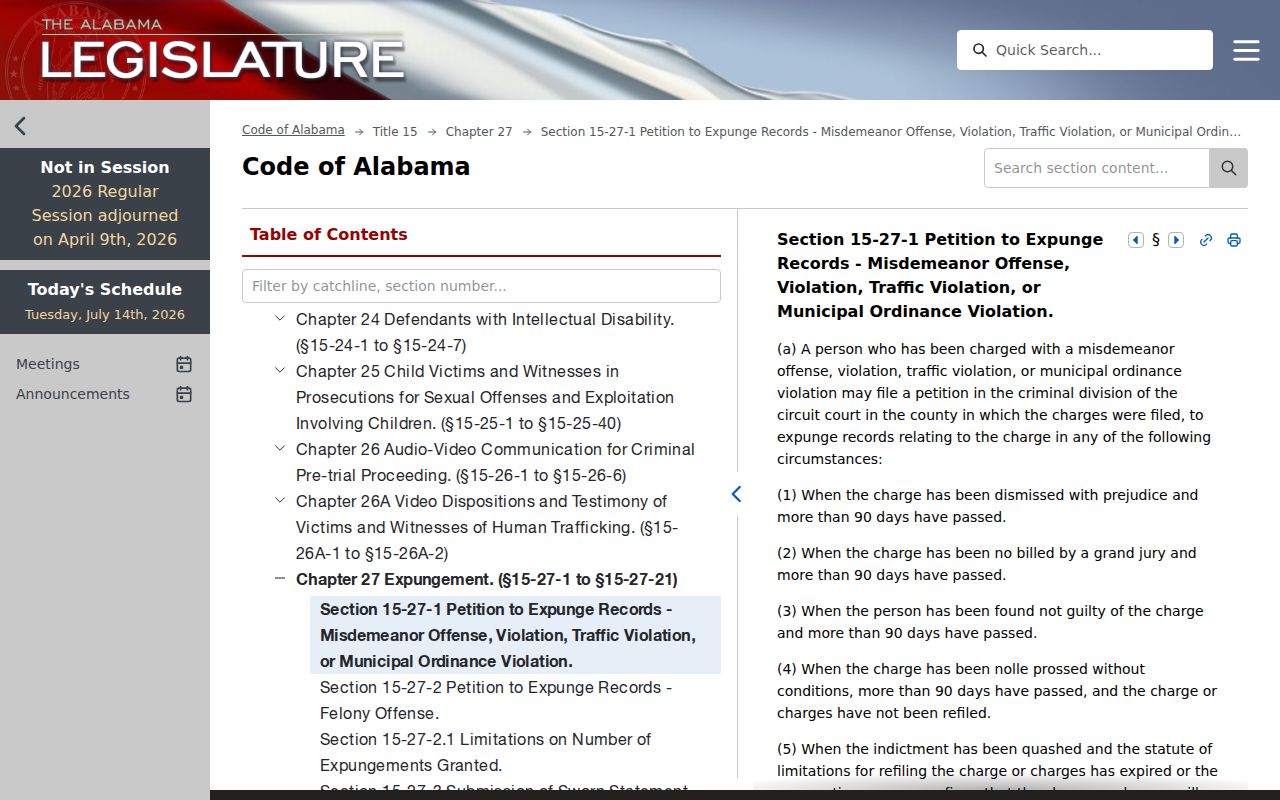
The statute supports why dismissed or qualifying criminal records may not remain available in the same way as ordinary public case files.